"One good analogy is worth three hours discussion." - Dudley Field Malone
Over the years I have seen so many complicated concepts vanish into the nether void of the courtroom. Moreover uncomplicated concepts or facts which became bogged down in lawyer speak. One of my jobs as a trial consultant is to assist with breaking down these concepts and facts. The end result is to use visual communication as a tool to help a jury absorb and understand this information. One of the biggest tools in assisting with this goal is a good analogy. An analogy is defined as non-identical comparisons between two things, with a resulting similar explanatory effect.
The best case teams I have worked with over the years have mastered the use of analogy in their presentations. This has been a constant tool and point of interest in my professional career. One of the first things I do when I join a trial team is read all the expert reports. This gives me an instant foundation of the case to work from. Then I begin thinking critically toward analogies both oral and visual which may assist a jury. Facts and comparisons are useless if the twelve most important people in the world do not understand them.

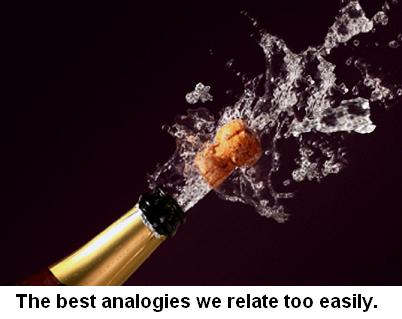
Teaching the jury with common sense comparisons is helpful to any presentation. I once worked on a case where the trial team had to explain a cystoscopy and stone extraction with stent placement. The stone removal and draining of the infected urine into the bladder was an important part of the case. The analogy of a champagne bottle being uncorked was used to explain to the jury the force of which the infected urine was released from the ureter. This is an example of a very simplistic analogy that everyone could relate too. We then used several demonstratives/animations with Trial Director to further bolster this analogy during our expert’s testimony.
Analogies can also assist with the theme of any case. This is especially true in product liability cases which are often ripe with analogous and comparable information. Even though there are distinct differences between consumer and professional products they are often begging for creative analogies. Juries love having something they can latch onto for their deliberations. The trial team must be prepared to create that “light bulb” moment so the jury has the sudden realization that they have encountered something similar before.
Having your presentation loaded with good visual communication and thought provoking analogies is the ultimate challenge in the modern courtroom. Getting a jury to always come back to the theme and REALLY absorb the relevant data of the case is the most difficult task for any trial team. Add the pressure of breaking down complicated information to twelve laymen, and believe me, it’s very true.
Anything less and the trial team will run the risk of falling on deaf ears. If you don’t believe me watch the jury. Those paying attention and nodding their heads if you are lucky are getting it.
All five of them.
Reference
Viewing Metaphor as Analogy, in Analogical Reasoning: Perspectives of Artificial Intelligence, Cognitive Science, and Philosophy (D.H. Helman, 1988).



No comments:
Post a Comment